Your Form Is Coachable.
AI running gait analysis, built around your injury. Most running pain traces back to a
movement pattern, and a movement pattern is something you can see on video and change.
Record a 60-second side-view video and tell us where it hurts. GaitLab Coach reads your stride
frame by frame, scores it 1–10, and points to the form flaw most likely behind your pain,
with a 4-week plan to work on it. Sixteen named injuries.
Free to start. No account. The full report is $4.99, once.
★★★★★
5.0 App Store rating
Method tested in a 320-runner RCT
Free to start, no signup
iOS & Android
16
Named Injuries Covered
$4.99
Once. Yours For Good.
Free
To Start. 5 Analyses / Day.
A Quick Tour
Your Phone, Your Running Coach
One side-view video becomes a full biomechanics form check, weighted toward
the injury you flag. Swipe through to see how it works.
Simple 3-Step Process
How GaitLab Works
01
Flag Your Injuries
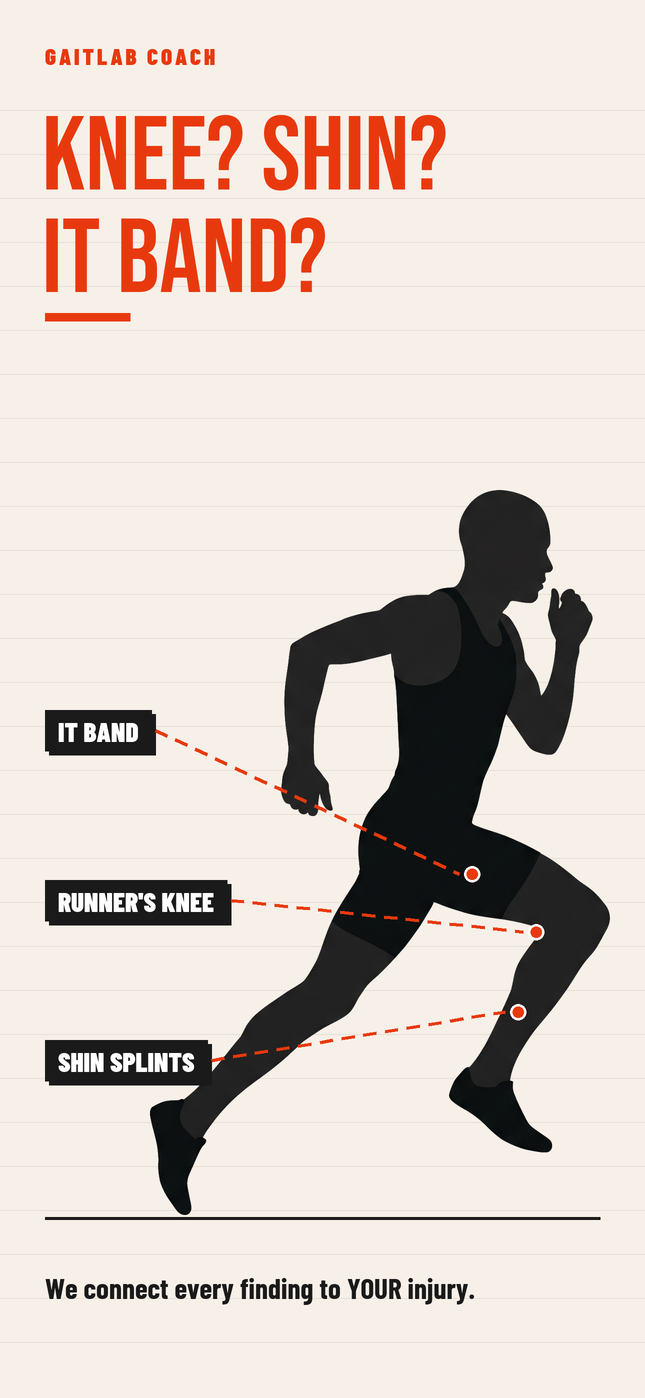
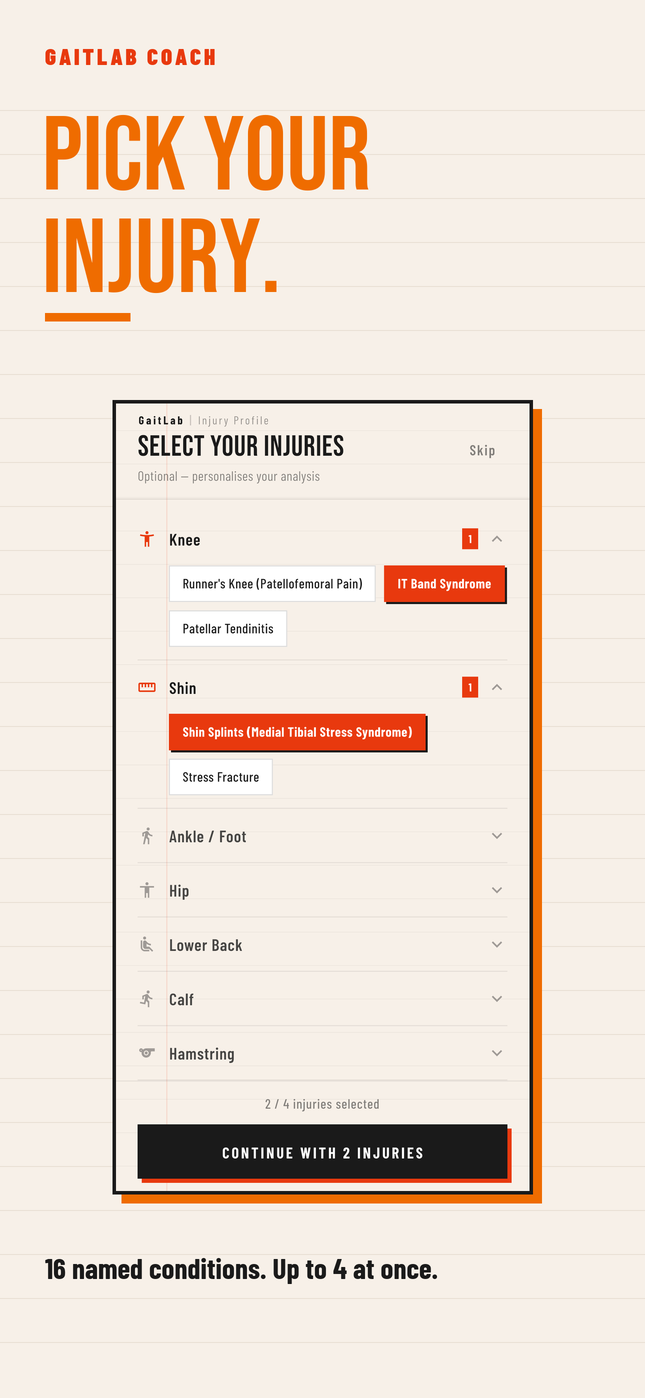
Pick from 16 injuries, such as runner's knee, IT band syndrome, Achilles tendinopathy, shin splints, or plantar fasciitis. The analysis knows what to look for before your video starts.
02
Record Your Run
Set your phone at hip height, 10–15 feet away, and run past at your normal pace for 30–60 seconds. A side view shows the patterns that matter most.
03
Get Your Plan
You get findings ranked by how much they matter for your injury, a 1–10 form score, and a 4-week drill plan to work through.
Inside Your Report
What The 4-Week Plan Looks Like
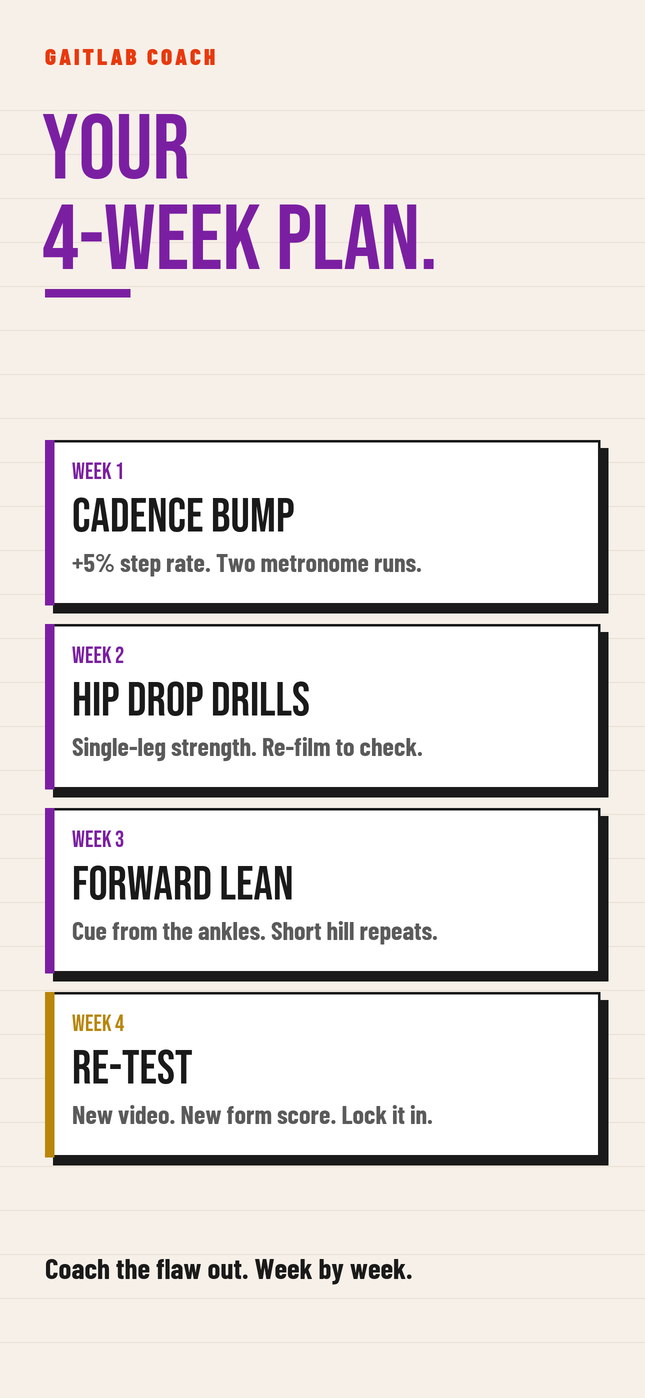
Every full report includes a week-by-week progression rather than a generic stretching sheet.
Drills move on only after the cue they reinforce has settled in. This is an example of the structure
for a runner who flags runner's knee (patellofemoral pain).
Week 1
Cadence Bump
Add 5% to your current step rate. Two 20-minute runs with a metronome. Goal: lower knee load before adding strength work.
Week 2
Hip Drop Drills
Single-leg bridges and side-plank clamshells, 3× a week. Re-record at the end of the week to check whether the pelvic drop has narrowed.
Week 3
Forward Lean
Cue a slight lean from the ankles (3–5°). Short hill repeats reinforce the pattern.
Week 4
Re-Test & Lock In
New video, new form score, new elite radar overlay. You can export a shareable reel of the result.
Plans are generated per analysis. Drills, volume, and progression adapt to your flagged injury, finding severity, and measured cadence.
The Science
The Evidence Behind The Coaching
"Your form is coachable" sums up what the gait-retraining research shows. In the largest
randomized trial in the field, runners coached to lower impact loading had 62% fewer
injuries over a year than runners who weren't. The cues GaitLab Coach uses are the ones that trial,
and the reviews that followed it, support.
📚
Chan et al. 2018, AJSM
320 novice runners. 2-week gait-retraining program targeting impact loading. 62% lower injury rate at 12-month follow-up vs. controls (16% vs. 38%). PubMed ›
🕐
Cadence +5–10%
A small bump in step rate reliably lowers vertical loading, knee load, and hip load, and it doesn't hurt running economy. Sports Health systematic review, 2025.
💪
Lower impact loading
Real-time feedback on tibial shock cut vertical loading rate by about 30% over 8 sessions, and the change held at follow-up (Crowell & Davis, Clinical Biomechanics, 2011).
⚠️
"Just run naturally" is wrong
About half of recreational runners get hurt in a given year. Your default stride is a habit, not an optimum. The changes with evidence behind them are small and specific, not a rebuild of your stride.
Cited Peer-Reviewed Research
For the full citation chain (the JOSPT 2022 meta-analysis, the biofeedback reviews, and the cadence
and overstride studies we use to rank findings), read
what the data says about running form
on our blog. The in-app "The Science" screen carries the same references.
Honest By Design
References last reviewed September 2026. GaitLab Coach flags movement patterns the literature links to overuse risk. It can't tell you what is wrong with a tissue, and no app can promise you'll never get hurt. For sharp or persistent pain, see a physio or sports-medicine clinician.
By The Numbers
Four Numbers Worth Knowing
62%
Fewer injuries in a 320-runner RCT (Chan et al. 2018, AJSM)
60s
Side-view phone clip is all the AI needs to grade your form
16
Named running injuries the AI maps to your gait findings
5.0★
App Store rating to date, from a small but unanimous set of reviews
Why It Matters
A Running Injury App Built Around Where It Hurts
Roughly half of all recreational runners pick up at least one injury a year
(Sports Med Open, 2023).
Most of those are overuse injuries: the same movement pattern, repeated thousands of times per run.
A runner with knee pain needs different advice from a runner with a sore Achilles, and
GaitLab Coach handles them differently.
Before you record, tap the body-area selector to flag your injury: knee, hip, shin, ankle, or
foot. The analysis then weights its findings toward the patterns that load that tissue, and each
finding points to the frame in your video where it shows up.
What You Get
Every Analysis Includes
🧠
Form Score
A 1–10 score based on the severity of what the analysis finds. Re-test after your plan and track it across sessions.
🔍
Injury-Specific Findings
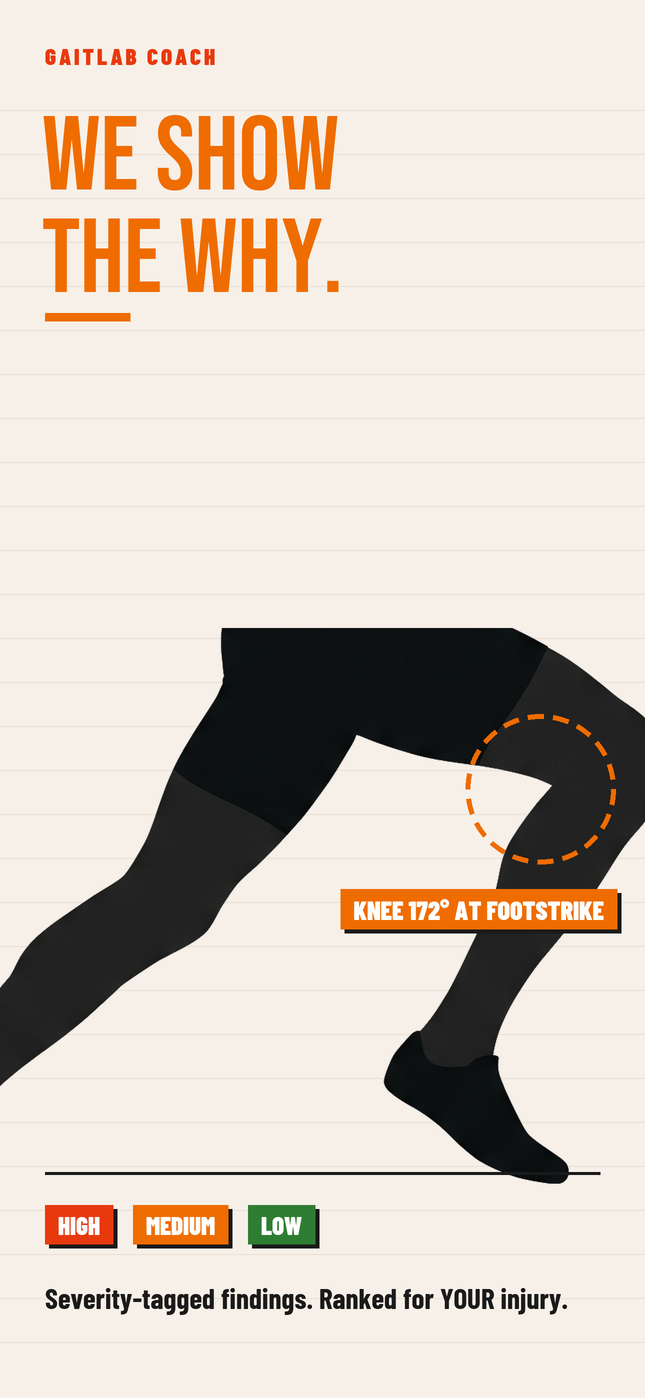
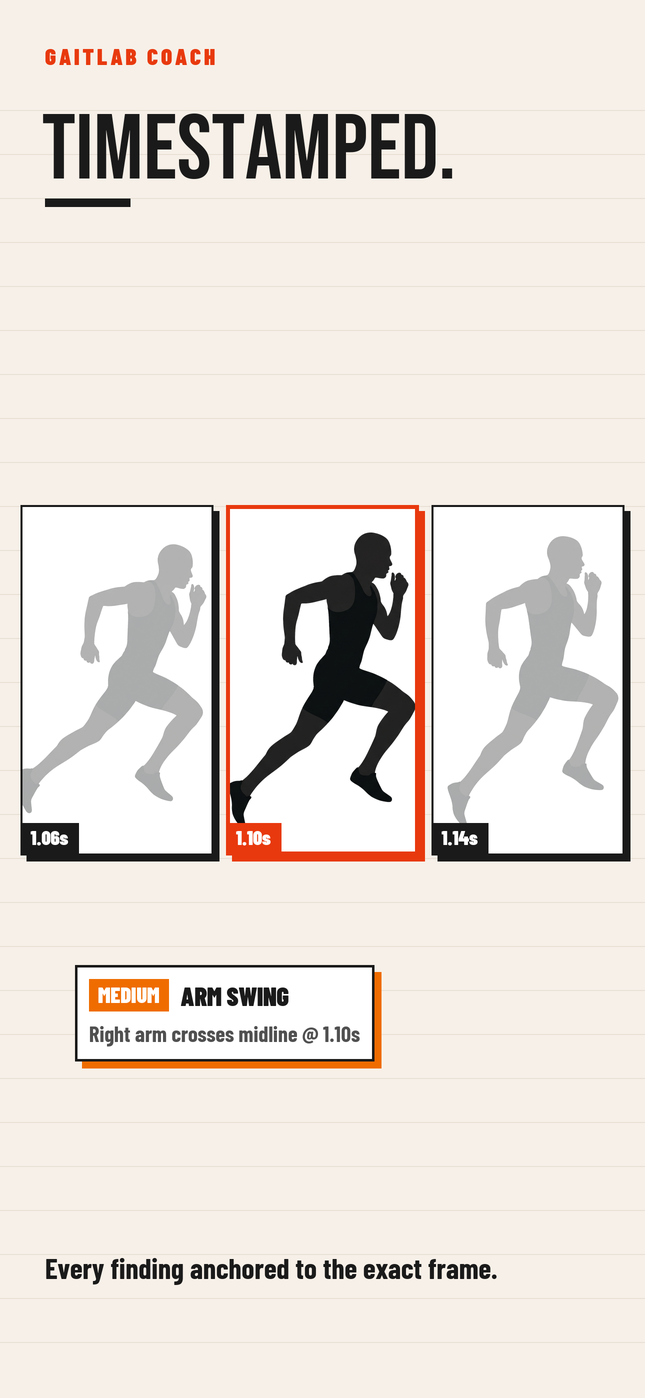
Cadence, overstriding, foot strike, hip drop, ranked by how much each matters for your injury, each tied to a timestamp.
📊
Elite Comparison
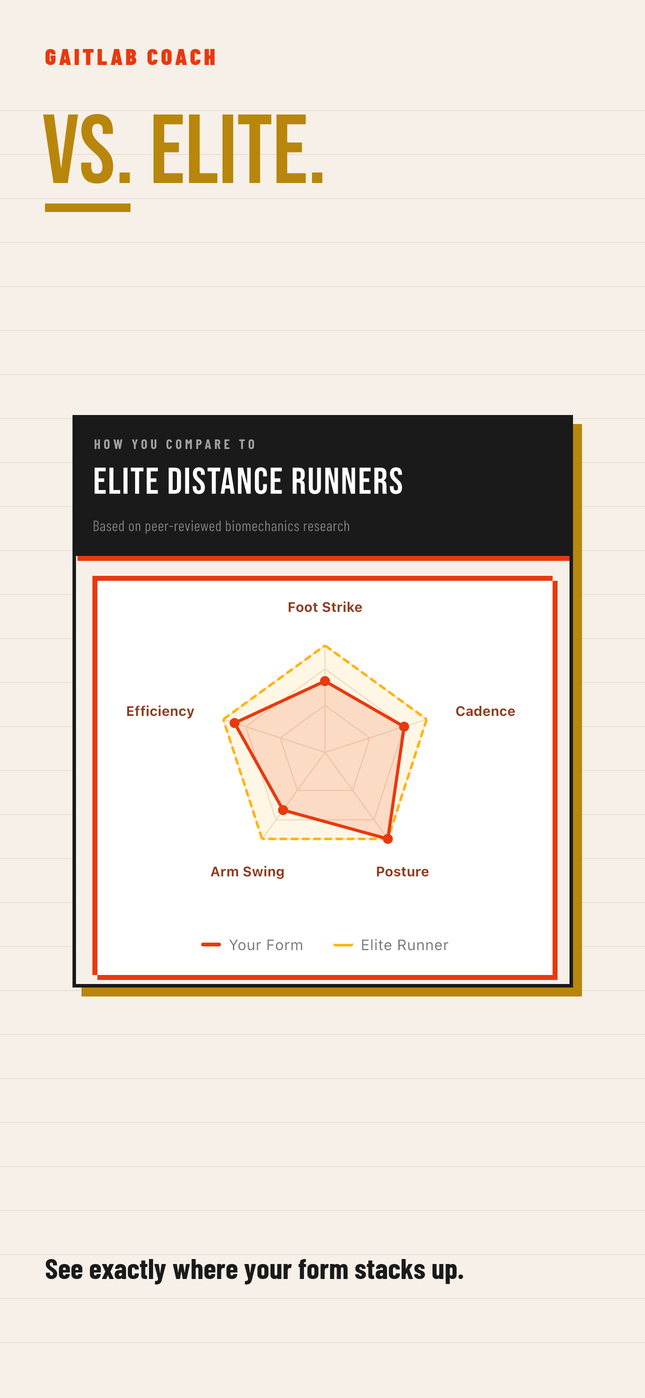
A radar chart of your form against an elite-runner benchmark, so you can see which dimension to work on first.
💪
4-Week Training Plan
Corrective drills chosen for your injury and findings: metronome runs, hip strength, calf eccentrics.
💬
Ask Coach
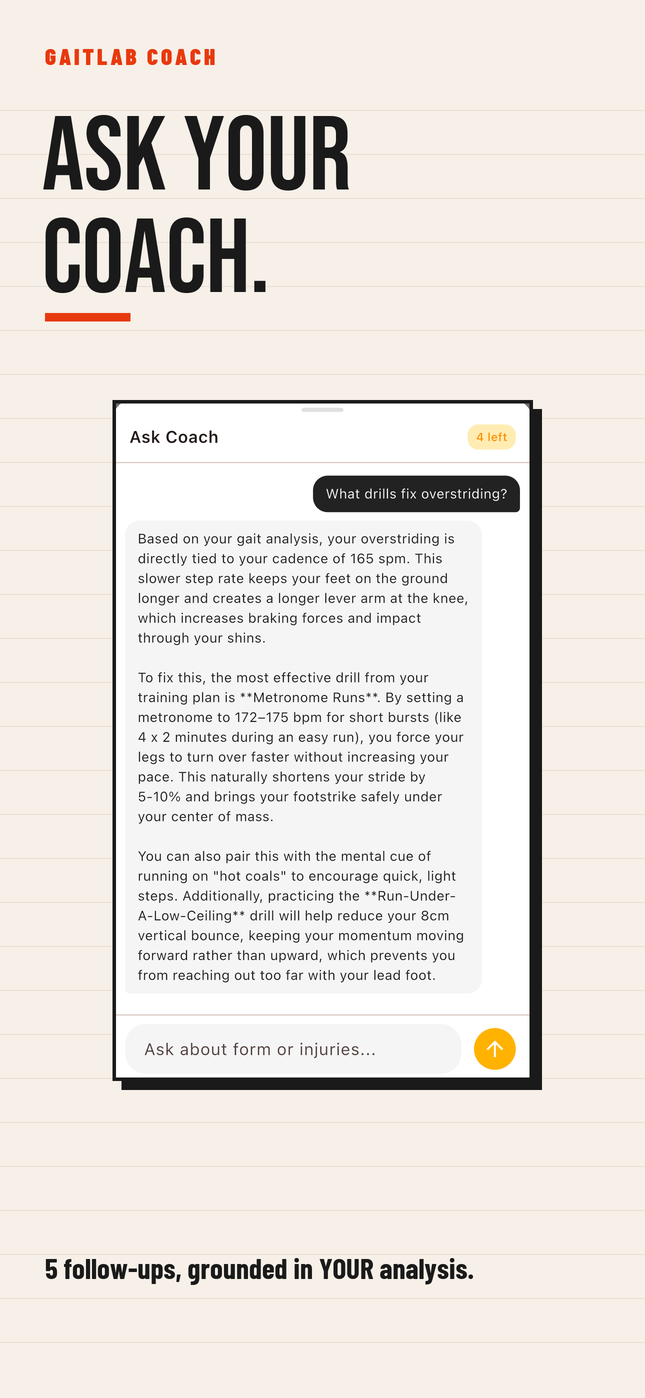
Ask up to five follow-up questions per analysis, answered from your own results. For example, "Which of these drills should I start with?"
💡
Daily Tip Streak
A short running form tip each day, with a streak to keep you coming back.
Built For
Three Runners. One App.
GaitLab Coach is built for three situations where form matters most.
The Injured Runner
Hurting And Sidelined
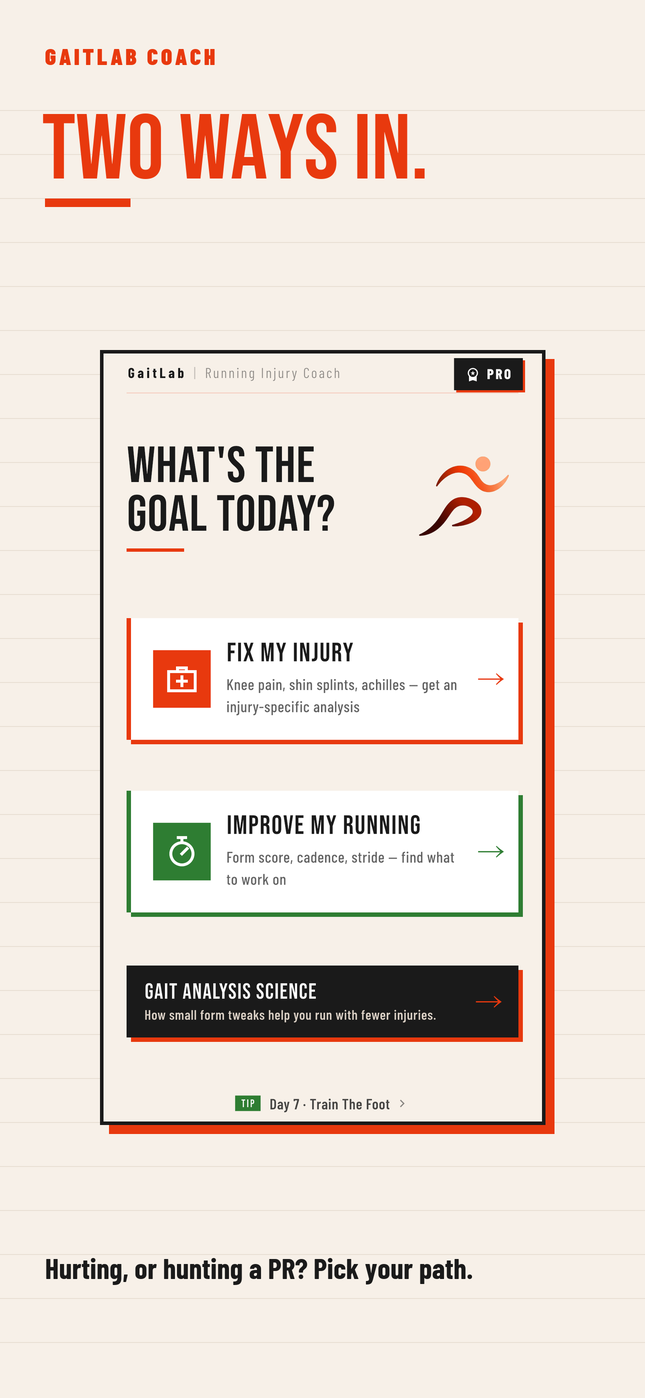
Knee, shin, or Achilles pain is cutting your runs short. Flag the injury, record once, and get findings and a plan tied to that injury instead of a forum thread.
The PR Chaser
Chasing A Faster Marathon
You're healthy but suspect your stride is costing you. The elite radar comparison shows which dimension of your form (cadence, vertical oscillation, knee drive) sits furthest from the benchmark.
The New Runner
Avoiding The First Injury
New runners get injured at more than twice the rate of experienced runners per hour run (Videbæk et al., 2015). Catch overstriding and low cadence while the habit is still young.
Injury Guides
Explore Injury-Specific Running Form Guides
Each guide covers which form patterns matter for one injury, what a side-view video shows,
and how GaitLab Coach weights the form check when you flag it.
Compare
GaitLab Vs. The $200 Clinic Visit Vs. Other Apps.
Most runners don't have a gait lab on call. This is how an at-home analysis compares with a clinic visit and with other running form apps.
| Feature |
GaitLab Coach |
Clinic Gait Lab |
Other Running Apps |
| Cost |
Free to start
$4.99 one-time unlock |
$150–$300 / visit |
$60–$70 / year |
| Where it happens |
Your phone, any sidewalk |
In-person appointment |
Your phone |
| Turnaround |
~60 seconds |
Same day to several days |
Minutes |
| Tied to your injury |
Yes, 16 named conditions |
Yes |
No, generic form score |
| Grounded in gait-retraining research |
Yes, see The Science |
Varies by clinic |
Rarely cited |
| 4-week corrective plan |
Included |
Usually extra cost |
Generic drills |
| Account required |
No account |
Yes |
Usually |
FAQ
Questions Runners Ask Before They Record
Can I do video gait analysis at home with my phone?
Yes. GaitLab Coach is built for at-home video gait analysis from a side-view clip recorded on your phone. It reviews your mechanics and weights the findings toward the injury you select before recording.
Is GaitLab a running injury app or just a form checker?
Both. It works as a biomechanics form check, and it connects the gait faults it finds to the injury you flagged, so the plan you get is about that injury rather than generic running advice.
What does the form check measure?
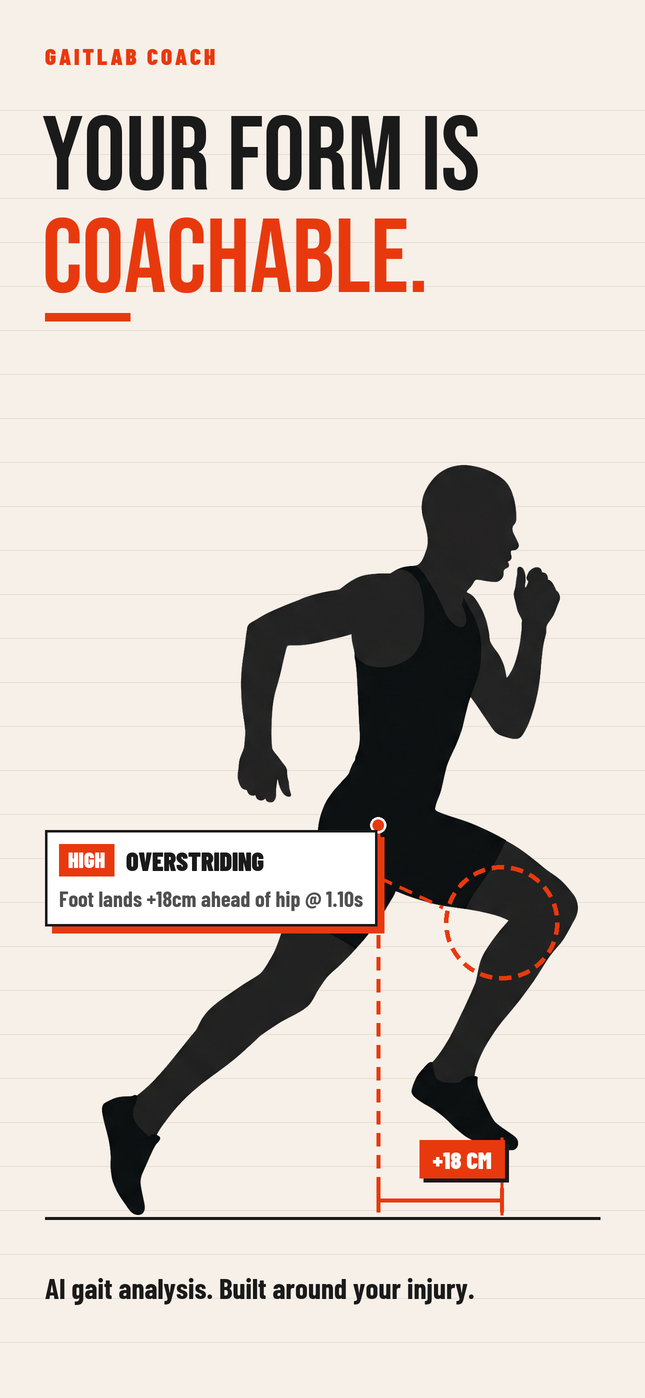
Foot strike, cadence, overstriding (where your foot lands relative to your hips), stride length, vertical oscillation, hip drop, arm swing, and trunk lean. Cadence is measured on your device from the video's motion signal. Findings are ranked by severity and turned into a corrective plan.
Which running injuries does GaitLab cover?
16 named running conditions across the knee, shin, ankle and foot, hip, lower back, calf, and hamstring, including runner's knee, IT band syndrome, Achilles tendinopathy, shin splints, stress fractures, and plantar fasciitis.
How is GaitLab different from Ochy or other running analysis apps?
GaitLab Coach ties video gait analysis to a named injury. You pick where it hurts before recording, and every finding points to a frame in your own video. It's free to start (5 analyses a day), and the full report with elite comparison, Ask Coach follow-ups, and reel export is a one-time $4.99 unlock. Ochy runs $60–70 a year; GaitLab is $4.99 once.
Can GaitLab replace a $200 clinic gait analysis?
Not entirely, and it isn't meant to. A lab measures forces and 3D joint angles that a phone camera can't. What a side-view phone video does show is the set of patterns the gait-retraining research targets: overstriding, cadence, hip drop, trunk lean. For most recreational runners with form-related pain, that is the useful part, and you can repeat it every four weeks. For acute trauma, suspected stress fractures, or pain that isn't improving, see a sports-medicine clinician.
Is 60 seconds enough for gait analysis?
Yes. A 30–60 second side-view clip at your normal pace contains dozens of stride cycles, enough to read foot strike, cadence, overstriding, and vertical oscillation.
5.0 ★★★★★
Every App Store review so far is five stars. There aren't many yet, so
read them yourself and decide.
Start Today
Your Form Is Coachable.
Start With One Video.
Record 60 seconds, flag your injury, and see which pattern to work on first.
Free to start. 5 analyses a day. $4.99 once for the full report.